
Venice is always worth visiting. During the Biennale, it becomes something stranger: it seduces you with beauty, then reminds you that beauty carries money, power, violence, desire, memory, shame, protest, ego, craft, and longing. It makes you walk through history in comfortable shoes and then punishes you anyway.
This year's Biennale carried a shadow before it even opened. Koyo Kouoh, the Cameroonian-born director of Zeitz MOCAA in Cape Town and the first African woman appointed to curate the Biennale, died suddenly in May 2025, only months after her appointment. Her chosen advisers continued the exhibition and carried forward her vision, In Minor Keys.
Then, nine days before the opening, the jury resigned. Their reason was explicitly political: they refused to award prizes to countries whose governments or leadership faced charges of crimes against humanity at the International Criminal Court, naming Israel and Russia. I personally applaud this decision. Protesters drew a historical parallel with South Africa's exclusion from the Biennale between 1968 and 1993. Pussy Riot staged a protest in front of the Russian pavilion. And on the way back, a pathway reminded visitors of the horrors unfolding in Ukraine because of the Russian invasion.
Art has always been political because human choices are political. Even silence has a position.
Once again, the old fantasy collapsed: art somewhere over here, politics somewhere over there. No. Art has always been political because human choices are political. Even silence has a position. Even living inside an oppressive system does not absolve anyone from daily moral decisions. Никто не остаётся в стороне.
The atmosphere around the Biennale captured exactly the world we are living in: old institutions losing their ability to regulate violence, old rituals losing their authority, realpolitik returning without shame. Kouoh's theme, In Minor Keys, was about something more subtle, but the whole city seemed to play in that register: grief, resistance, memory, beauty, and the low vibration of history under your feet.
There are many remarkable works at the Biennale, and contemporary art is generous in that way. You can enter it without context and still find something that touches you. Though I do recommend reading the curatorial notes. Sometimes they ruin the mystery. Sometimes they unlock it.
The Japanese Pavilion was playful, absurd, and unexpectedly moving. Ei Arakawa-Nash's Grass Babies, Moon Babies invites visitors to carry, care for, and change the diapers of 208 baby dolls wearing sunglasses. The babies have different skin tones and QR codes that generate poems linked to their birth dates, almost like a fortune at a Shinto temple. Some hang in the air. Some sit in groups. Some look abandoned in the garden.
At first, it feels hipsterish and funny. Then it becomes more complicated. Arakawa-Nash speaks about parenthood, community, empathy, and the ultranational footprint of Japanese history — especially the way Japan's aggression was later partly obscured by its own victimhood after Pearl Harbor.
That pavilion stayed with me because it raised a brutal question: how do modern states process guilt once they have learned to narrate themselves as victims? Germany, after Nazism, accepted responsibility and still carries that shame publicly. That deserves respect. I kept wondering how Israelis, Russians, and Americans will one day reckon with their own histories of aggression. How does a nation decide which violence it remembers, which violence it excuses, and which violence it wraps in the language of security, destiny, or geopolitical necessity?
The Polish Pavilion took me somewhere else entirely. Liquid Tongues, by Bogna Burska and Daniel Kotowski, is a trance. The Choir in Motion — a group of hearing and Deaf performers — sings and signs compositions inspired by humpback whale songs and Roger Payne's landmark recordings. From large screens, people in red bathing suits look down at you as if from another dimension. There is no starry sky, only bodies, water, sound, and gesture. The choristers perform underwater because their voices, unlike those of hearing people, are not distorted beneath the surface.
The result is less an installation than a sensation. You do not fully watch it. You enter its frequency.
The Greek Pavilion was darker. Andreas Angelidakis transformed the space into an escape room: part Platonic cave, part S&M nightclub, part post-apocalyptic civic nightmare. At its center is Zak Kostopoulos — Zackie Oh — the Greek-American drag artist and HIV-positive activist beaten to death in Athens in 2018. His face appears on T-shirts throughout the space like an icon.
The pavilion moves through a totalitarian reality of social punishment: the condemnation of queers, outsiders, bodies that refuse obedience, people who step beyond the approved boundaries of normality. It is theatrical, claustrophobic, and necessary.
Feminism appeared throughout the Biennale in a way I appreciated: organically, without becoming a predictable agenda. Even the provocative Austrian Pavilion, commanded by Florentina Holzinger's modern Amazons, was making an ecological argument as much as a feminist one.
Her SEAWORLD VENICE transformed the pavilion into a flooded post-apocalyptic world where the human being becomes an endangered creature, almost a species in the Red Book. Naked female performers live in a flooded pavilion — a water tank behind glass, like a specimen in a cabinet of curiosities. Women with extraordinarily powerful bodies move through the space — showing us not femininity but the strength of the body — suspended from a great iron bell, circling on a jet ski, performing underwater. In the pavilion you can use a biological toilet, and your filtered urine cycles back into the tanks. The art piece makes this invisible cycle of the water circulation visible to everyone.
Beyond the Giardini and Arsenale, Venice keeps producing accidental discoveries. You walk through the city, see a poster, turn into a palazzo, and suddenly another exhibition opens a hidden room in your brain.
That is how I found Tadeusz Kantor and Maria Jarema at the Procuratie Vecchie on Piazza San Marco. I knew Strzemiński and Kobro, but here was another iconic Polish pair: artistic collaborators, co-founders of the legendary Cricot 2 theatre group, central figures of the postwar avant-garde. The exhibition, Emballage, Cricotage and Madame Jarema, made Kantor feel immediate to me. His deep brushstrokes, embedded materials, umbrellas, colors, textures — everything seemed designed to transmit emotion through matter itself.
At the Gallerie dell'Accademia, Marina Abramović was given the building for Transforming Energy, her exhibition marking her 80th birthday. She is the first living woman to have a solo exhibition there. From Abramović, I expected more pain, fear, provocation, endurance. Instead, the show felt like a meditative rethinking of time: the centerpiece is her Transitory Objects — stone beds and structures embedded with quartz and amethyst — which visitors are invited to lie or sit upon, activating what Abramović calls "energy transmission." The tactile is crucial to the experience.
At the Peggy Guggenheim Collection — alongside the incredible works of Pollock, Dalí, Miró, Modigliani, and Peggy knew Pollock — the temporary exhibition is dedicated to her first gallery in London, opened before the war. The show places particular emphasis on Ernst and Kandinsky. Kandinsky feels like home to me. In his works, as in Chagall's, there is always a sense of home — perhaps it is the rolling forms and varied half-tones that remind you of your roots. Perhaps it is just my own elaborate delusion.
Some exhibitions also take place in palazzi and historic buildings — visiting the masterpieces of medieval architecture is itself an aesthetic adventure.
At Museo di Palazzo Grimani — a rare example of Tuscan-Roman Renaissance architecture in Venice — the first Italian exhibition of Amoako Boafo is taking place, produced by Gagosian. For me it was also the first time I saw the Ghanaian artist's work in person. The exhibition, It Doesn't Have to Always Make Sense, begins with a short film about how the artist prepared the works for this occasion — and you sit there wrapped in Venetian black lace, as if under a shawl.
I love his colors, his thick gestural marks across all the canvases, and his signature finger-painting technique — where instead of a classical palette rendering skin texture, there are something like internal mechanisms, coiling forms. He is rethinking his heritage. What I loved most was how he incorporates Venetian imagery and Venetian lace into his canvases — that is the true jewel of this collection.
And then came The Only True Protest Is Beauty — the inaugural presentation of the Fondazione Dries Van Noten at Palazzo Pisani Moretta, curated by Dries Van Noten and Geert Bruloot.
It is the most powerful curator work of embedding costumes story as its own narrative I've seen so far, and I was surprised when I discovered that it was Dries Van Noten himself.
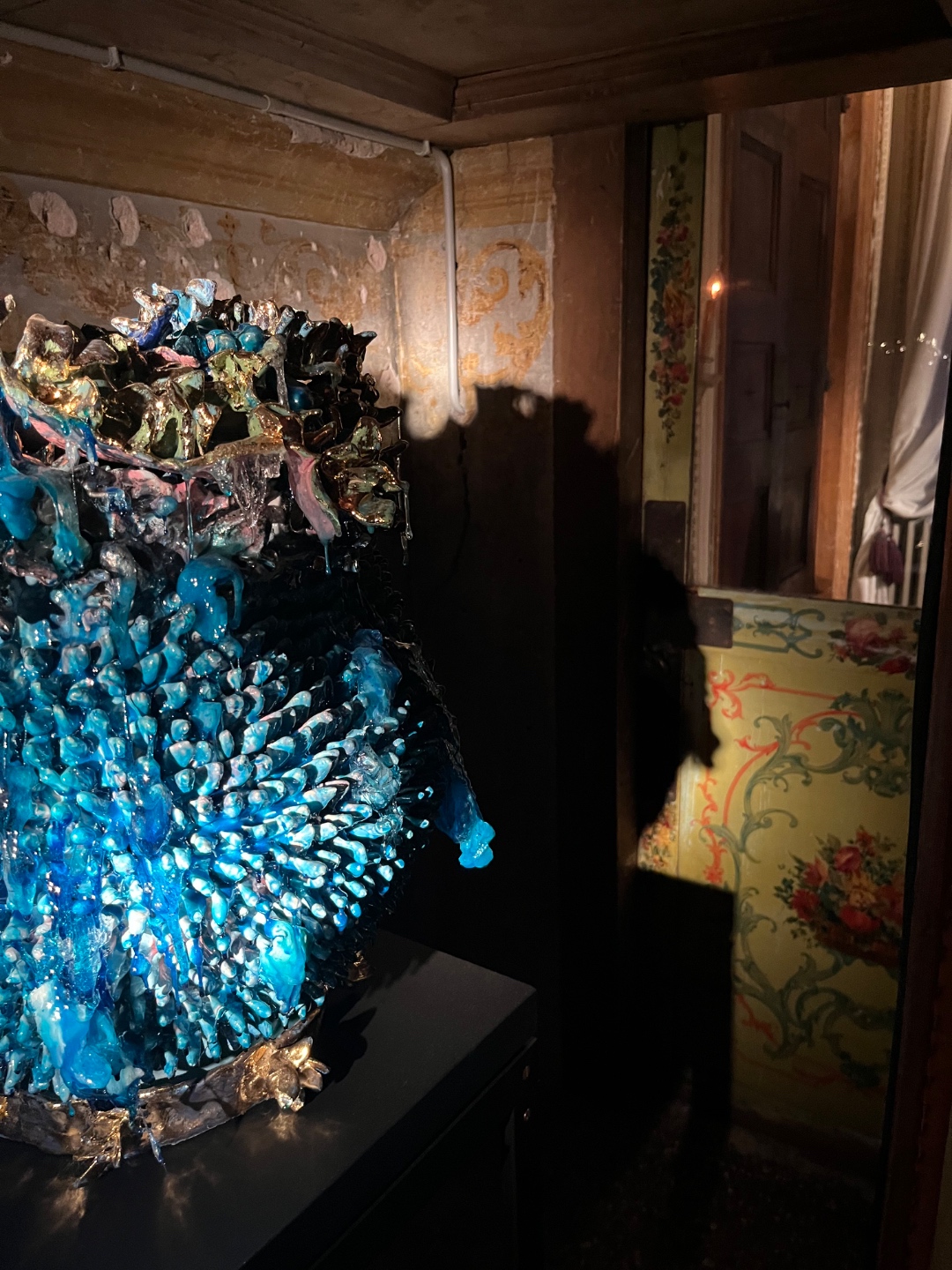
You walk through Baroque and rococo interiors, frescoed ceilings, and centuries-old architectural details, all accompanied by the sound of live operatic singing. The dresses, the glass, the mirrors, the chandeliers, the furniture, the shadows — everything speaks to everything else.
And suddenly you understand that beauty can be a form of protest. Fashion too.
Coco Chanel telling women they could wear trousers. Women removing their bras. Men finally being allowed to be sexy, to wear tapered trousers, to treat clothing as more than uniform. Fashion has always been self-expression for me, a second skin. But here I began to think about beauty as resistance: especially beauty that refuses the standard, beauty that disobeys what we were trained to admire.
The Lacroix gowns were magnificent: voluminous skirts, lace-up shoes, ostrich feathers, gold threads, fabric that demanded inspection. Venetian glass appeared everywhere, echoing the chandeliers above. Chairs became sculpture. Mirrors multiplied the room. You could get stuck on a single detail and lose the whole century.
There were references embedded everywhere: old couture, contemporary symbols, Dries Van Noten's own archive, fragments of fashion history folded into one another. It was fashion-as-spectacle, couture as object, clothing as memory, beauty as argument.
Then you leave the palazzo, walk along San Marco, and see a sweater and jeans in the Chanel boutique window. Or something in Zara that could almost pretend to be the same idea after the magic has been drained out of it. And suddenly you look differently. You notice the cut, the labor, the imagination, the theft, the dilution, the difference between reference and reproduction.
That is what a good exhibition does. It changes your eyes.
And Venice does this better than almost anywhere else. This still-medieval city is strangely free. Venice holds contradictions without trying to resolve them. On one side, elegant palazzi, foundations, collectors, donors, institutions supporting and displaying art. On the other, independent art is everywhere — raw, excessive, conversational, sometimes chaotic, sometimes brilliant — the kind that would exist even without sponsors because it simply breaks out from people.
You see the young artists coming out of the Accademia di Belle Arti — a little anarchist, a little communist, a little punk. They keep creating. They keep showing what is happening and what has already happened through visual art, through performance, through objects, through bodies, through their own stubborn need to make something visible.
Because true protest starts with art. Before it becomes a slogan, a movement, a manifesto, or a political demand, it begins with someone seeing the world differently and insisting on showing it to others. Art catches what society tries to normalize, hide, decorate, excuse, or forget. It makes the invisible visible. It gives form to discomfort. It turns private perception into public evidence.
You leave Venice exhausted, overstimulated, slightly more educated, slightly more confused, and deeply convinced that art still matters. Maybe especially now. In a world slipping into brutality and realpolitik, art may be one of the last languages capable of holding complexity without flattening it.
The only true protest starts with art. And only then, perhaps, beauty becomes protest too.